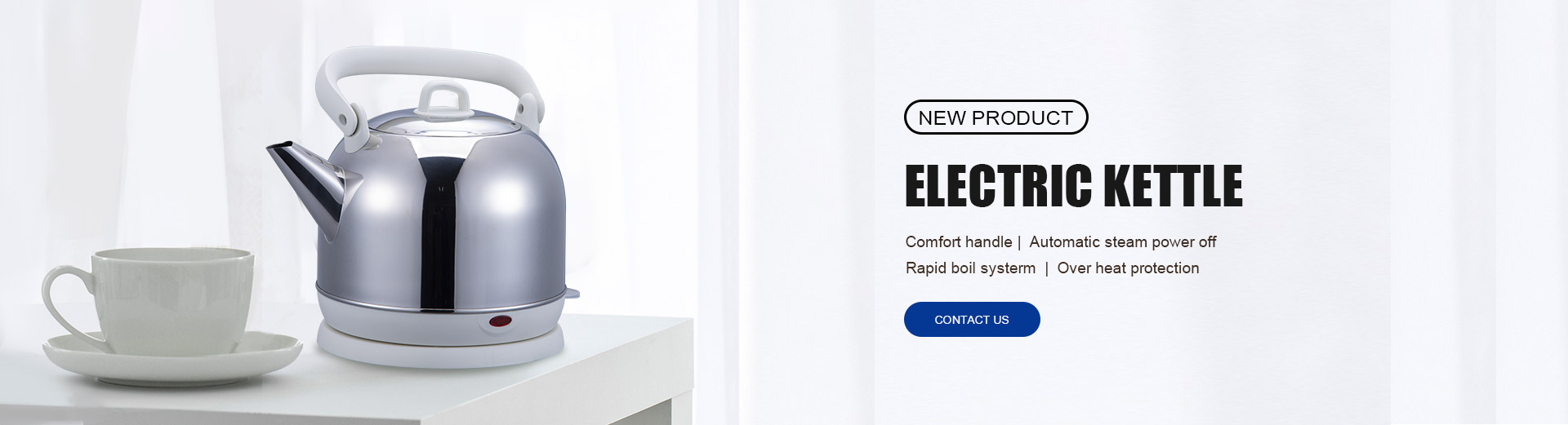
This overview outlines the testing procedures involved in the production of stainless steel electric kettles, covering materials, electrical safety, heating performance, leakage prevention, structural integrity, and compliance with export standards.
An analysis of key manufacturing technologies for enhancing the quality of stainless steel electric kettles, covering forming, welding, surface treatment, automated manufacturing, and quality inspection.
This overview outlines the complete manufacturing process for stainless steel electric kettles, covering key production stages such as stamping, welding, surface treatment, assembly, and quality inspection.
This article introduces common surface treatment processes for stainless steel electric kettles and analyzes the impact of brushed, polished, matte, and colored coating finishes on product appearance and performance.
Choosing a large capacity electric kettle requires careful consideration of volume, heating performance, safety features, material quality, and application requirements. Compared with standard household kettles, large capacity models need stronger structures and more stable heating systems to support higher water demand.
Choosing the right electric kettle size depends on usage requirements, application scenarios, heating efficiency, and product design expectations. A suitable capacity can improve user experience, reduce unnecessary energy consumption, and ensure better daily convenience.
Choosing between a stainless steel electric kettle and a glass electric kettle depends on product performance, design requirements, durability expectations, and application scenarios. Both materials have advantages, but manufacturers need to consider more than appearance when developing reliable kitchen appliances.
Choosing the right material for an electric kettle directly affects heating performance, durability, safety, and user experience. For manufacturers, material selection is not only about appearance but also about product structure, food safety requirements, production efficiency, and long-term reliability.
Cleaning a stainless steel electric kettle regularly helps maintain heating efficiency, improve water quality, and extend product service life. Over time, minerals from water, especially in hard water areas, can accumulate inside the kettle and affect heating performance.
An electric kettle is one of the most commonly used small kitchen appliances for heating water quickly and safely. It is widely used in homes, offices, hotels, dormitories, and hospitality environments.
An electric kettle is usually better than a microwave when the main purpose is boiling water. Many electric kettles are rated around 1500W to 2200W and transfer heat directly to water through a heating plate or concealed element.
An electric kettle may overflow when water is filled above the maximum level mark, when the lid is not fitted properly, or when strong boiling pushes water toward the spout. At normal atmospheric pressure, water boils at about 100°C, and rapid bubbling can raise the water level during heating.