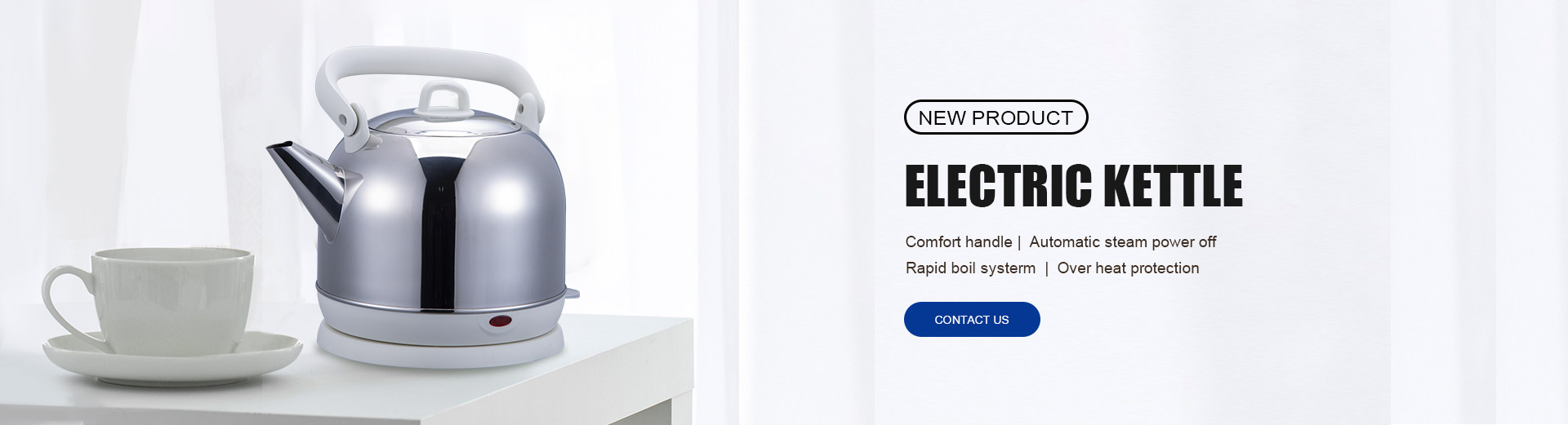
Fast boiling electric kettles provide quicker heating performance, while standard electric kettles offer balanced performance and cost efficiency. The better choice depends on user expectations, market positioning, and product requirements.
Boiling speed directly affects user convenience and overall appliance experience.
Modern consumers often expect kitchen appliances to provide:
Faster operation
Better energy efficiency
Simple user experience
Reliable performance
For electric kettle brands, choosing between fast boiling and standard designs requires considering:
Target users
Product positioning
Heating technology
Manufacturing cost
Both types can provide reliable performance, but they meet different market needs.
The main difference is the heating performance and product design approach.
Fast boiling kettles are designed to reduce heating time through:
Higher power output
Optimized heating elements
Improved thermal efficiency
They focus on speed and convenience.
Standard kettles provide:
Reliable boiling performance
Simpler structure
Balanced cost
They are widely used for everyday household applications.
Fast boiling electric kettles are designed specifically for shorter heating times.
They can improve user experience by:
Reducing waiting time
Improving daily convenience
Supporting frequent use
This is especially valuable for users who prepare multiple drinks throughout the day.
Standard electric kettles provide sufficient heating performance for normal household needs.
They are suitable when:
Boiling speed is not the main priority
Cost efficiency is important
Basic functions are preferred
Heating technology plays an important role in boiling efficiency.
Manufacturers optimize:
Heating element performance
Power configuration
Internal structure
Heat transfer efficiency
These improvements help increase heating speed.
Standard kettles typically focus on:
Stable heating
Reliable operation
Production efficiency
The design prioritizes balanced performance and affordability.
User experience depends on how consumers use the product.
Advantages include:
Less waiting time
Faster preparation
Improved efficiency
It is suitable for:
Busy households
Offices
Users who value speed
Standard kettles provide:
Simple operation
Easy maintenance
Reliable daily use
They meet the needs of users who mainly require basic boiling functions.
Energy efficiency depends on usage habits and product design.
Shorter heating time may help reduce energy consumption during frequent use.
Efficiency depends on:
Heating system design
Power management
Product structure
Standard models can also provide efficient performance through:
Suitable heating power
Proper insulation
Optimized design
The best choice depends on the balance between speed and operating requirements.
Manufacturing requirements vary between the two designs.
| Factor | Fast Boiling Electric Kettle | Standard Electric Kettle |
|---|---|---|
| Heating System | Optimized for speed | Designed for basic boiling |
| Product Cost | Usually higher | Usually lower |
| Technical Requirements | More advanced | Simpler structure |
| Target Market | Premium and convenience-focused | General household use |
| Production Control | Requires precise testing | Standard quality control |
Manufacturers need different production approaches depending on product requirements.
The right choice depends on brand positioning.
Suitable for:
Premium appliance brands
Technology-focused products
Convenience-oriented markets
Customization options include:
Heating system
Product appearance
Smart functions
User interface
Suitable for:
Large-volume products
Cost-sensitive markets
Basic household appliances
Manufacturers can optimize designs according to target pricing and customer expectations.
Production costs vary due to differences in components and technology.
Higher costs may come from:
Advanced heating systems
Higher power components
Additional testing requirements
Lower costs may result from:
Simpler structures
Standard components
Efficient mass production
The most suitable design depends on the relationship between product value and target price.
Premium markets often focus on:
User experience
Product innovation
Convenience features
Fast boiling kettles can support premium positioning through:
Faster performance
Modern technology
Improved daily efficiency
However, premium value can also come from:
Material quality
Design
Safety features
Brand experience
Fast boiling kettles require strict quality management.
Manufacturers focus on:
Checking:
Heating speed
Temperature control
Power stability
Evaluating:
Electrical protection
Component reliability
Product safety
Confirming:
Switch operation
Automatic shut-off
User functions
Professional testing ensures reliable performance.
Brands should consider:
Target customer needs
Market price range
Product positioning
Expected usage scenarios
Choose fast boiling designs when:
Speed is a key selling point
Premium experience is important
Users value convenience
Choose standard designs when:
Cost efficiency is the priority
Basic performance is sufficient
Large-volume supply is required
Fast boiling and standard electric kettles provide different user experiences.
Fast boiling kettles focus on speed, convenience, and premium functionality, while standard kettles provide reliable performance and cost efficiency.
The right choice depends on market requirements, customer expectations, and product strategy.
By selecting suitable heating technology and working with an experienced electric kettle manufacturer, brands can create products that deliver the right balance of performance, quality, and value.