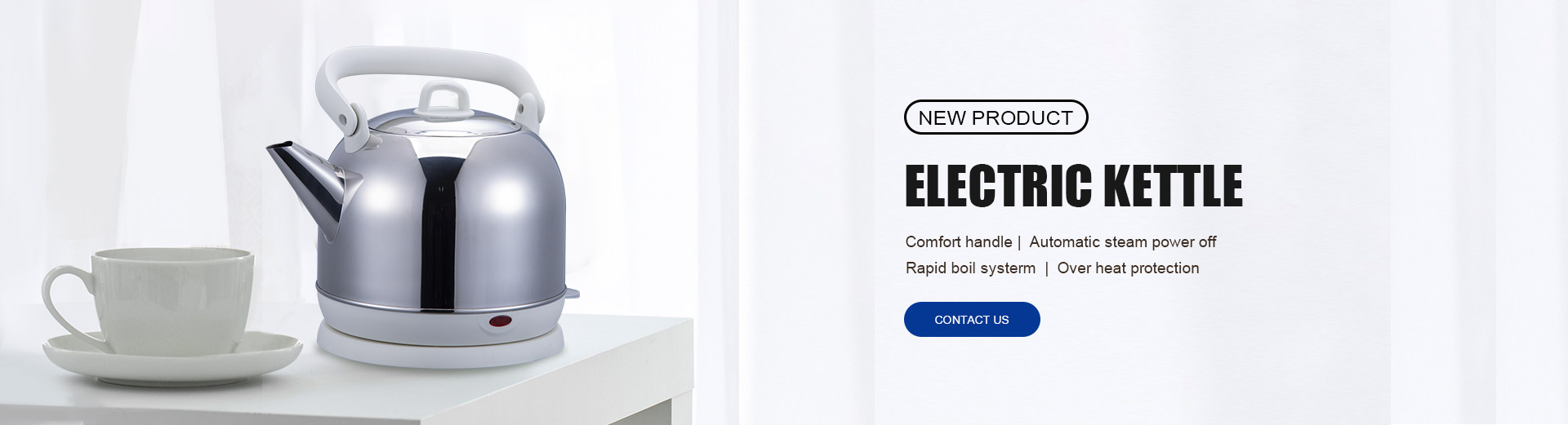
316 Stainless Steel Kettles are generally more suitable for premium products because of their higher corrosion resistance, while 304 stainless steel kettles provide a practical balance between performance, durability, and cost.
Material selection directly affects the durability, appearance, safety, and market positioning of electric kettles.
For premium electric kettle projects, stainless steel grade influences:
Corrosion resistance
Product lifespan
Surface performance
Manufacturing cost
Customer perception
304 and 316 stainless steel are both widely used materials, but they serve different product positioning strategies.
The right choice depends on:
Target market
Product price range
Usage environment
Brand positioning
The main difference between 304 and 316 stainless steel is their chemical composition and corrosion resistance.
304 stainless steel is widely used because it provides:
Good corrosion resistance
Reliable durability
Easy processing
Balanced cost performance
It is commonly applied in:
Household appliances
Kitchen products
General stainless steel components
316 stainless steel contains additional elements that improve corrosion resistance.
It provides:
Higher resistance to harsh environments
Better chemical stability
Premium material positioning
It is often selected for products requiring higher material performance.
Corrosion resistance is one of the biggest differences between 304 and 316 stainless steel.
304 stainless steel performs well in normal household environments.
It is suitable for:
Daily water heating
Standard kitchen use
General consumer appliances
316 stainless steel offers stronger corrosion resistance.
It is more suitable for:
Premium products
Demanding environments
Markets emphasizing material quality
For most household electric kettle applications, 304 stainless steel provides sufficient performance. However, 316 stainless steel offers additional protection for premium positioning.
Premium products usually focus on:
Material quality
Long-term durability
User confidence
Brand value
316 stainless steel supports premium positioning through:
Higher material grade
Stronger corrosion resistance
Advanced material perception
It can help brands create products positioned as high-quality kitchen appliances.
304 stainless steel can also support premium products through:
Excellent appearance
Reliable performance
Cost-effective quality
It provides a strong balance between product value and manufacturing cost.
Material grade directly influences production costs.
| Factor | 304 Stainless Steel | 316 Stainless Steel |
|---|---|---|
| Material Cost | Lower | Higher |
| Corrosion Resistance | Good | Higher |
| Processing | Easier and widely used | Requires careful control |
| Product Positioning | Mid-range to premium | Premium |
| Market Application | Wide range | High-end applications |
Manufacturers select materials according to product goals rather than always choosing the highest-grade option.
Manufacturing performance is an important consideration for OEM projects.
304 stainless steel is widely used because of:
Good forming performance
Mature processing methods
Stable supply availability
This helps manufacturers maintain efficient production.
316 stainless steel requires:
More precise material management
Higher material cost control
Professional processing experience
Experienced manufacturers can manage these requirements through proper production control.
Both materials can achieve premium appearances through proper finishing.
Common surface treatments include:
Brushed finish
Mirror polishing
Matte finishing
Custom coatings
304 and 316 stainless steel can both provide attractive designs when combined with professional surface processing.
The final appearance depends more on:
Manufacturing precision
Surface treatment quality
Product design
The suitable material depends on the project requirements.
The product requires:
Balanced cost and quality
Large-scale production
Reliable daily performance
Competitive market pricing
The product focuses on:
Premium positioning
Higher material expectations
Luxury appliance markets
Stronger corrosion resistance
Manufacturers can recommend suitable materials based on market positioning and production objectives.
Material choice influences how customers perceive product quality.
Provides:
Reliable performance
Practical durability
Competitive pricing
It is suitable for brands targeting broad consumer markets.
Provides:
Premium material positioning
Higher perceived quality
Stronger performance expectations
It is suitable for brands developing higher-end product lines.
Regardless of stainless steel grade, manufacturing quality depends on proper control.
Professional manufacturers manage:
Checking:
Material specifications
Supplier quality
Consistency
Monitoring:
Forming accuracy
Welding quality
Surface treatment
Testing:
Appearance
Structure
Product performance
Material selection and manufacturing control work together to determine final product quality.
316 stainless steel provides higher corrosion resistance, but it is not always necessary for every electric kettle application.
304 stainless steel remains a widely used material because it offers:
Good performance
Reliable durability
Better cost efficiency
The best choice depends on whether the product requires premium material positioning or practical value.
304 and 316 stainless steel both provide reliable solutions for electric kettle manufacturing.
304 stainless steel offers a strong balance of performance and cost, while 316 stainless steel provides higher corrosion resistance and premium positioning.
For premium electric kettle projects, manufacturers should evaluate market requirements, product positioning, and customer expectations before selecting the most suitable stainless steel grade.