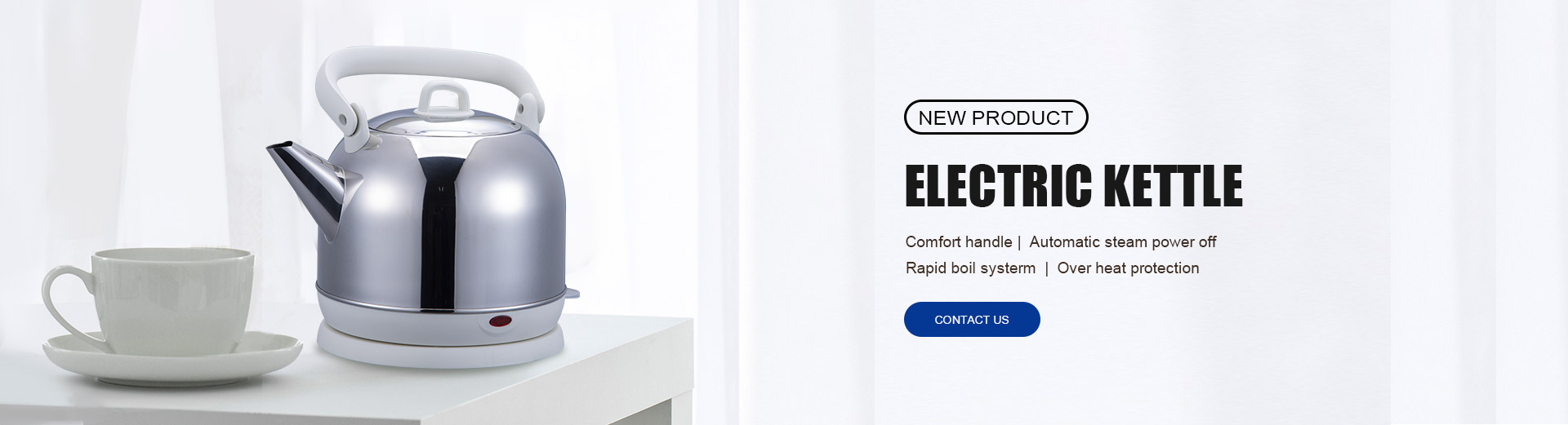
Factory quality management is important for OEM kettles because it ensures consistent production, product safety, manufacturing reliability, and stable quality across large orders.
OEM kettle production requires manufacturers to transform customer designs and specifications into reliable finished products. Unlike standard products, OEM projects often involve customized materials, structures, functions, and appearance requirements.
A strong factory quality management system helps control risks throughout the entire manufacturing process.
It supports:
Stable product performance
Consistent production quality
Reduced manufacturing defects
Better compliance with market requirements
Reliable long-term supply
For brands and distributors, choosing a factory with effective quality management is essential because product quality directly affects customer satisfaction and market reputation.
Quality management is not limited to final inspection. It covers every stage from product development to shipment.
A complete quality system includes:
Material control
Production process monitoring
Component inspection
Assembly management
Functional testing
Final verification
By establishing quality checkpoints throughout production, factories can identify potential issues earlier and reduce the risk of defective products.
Consistency is one of the biggest challenges in OEM manufacturing, especially for large-volume orders.
Quality management helps maintain consistency through:
Factories establish clear operating standards for:
Metal processing
Injection molding
Welding
Assembly
Testing
Standard procedures reduce variations caused by different operators or production conditions.
Manufacturers monitor key production factors to ensure each batch follows approved requirements.
Consistent processes help ensure that every kettle matches the approved sample in:
Appearance
Function
Structure
Performance
Material quality directly affects electric kettle safety and durability.
Factory quality systems manage:
Control includes:
Material grade verification
Surface inspection
Thickness checking
Factories evaluate:
Heat resistance
Mechanical strength
Dimensional accuracy
Quality management ensures:
Supplier reliability
Component compatibility
Safety performance
Proper material control reduces quality risks before production begins.
OEM projects often require customized product designs. Quality management helps ensure that designs can be successfully converted into mass production.
During development, factories evaluate:
Product structure
Material selection
Manufacturing feasibility
Assembly requirements
Prototype testing helps verify:
Functional performance
Component compatibility
Appearance quality
This process reduces the possibility of design problems appearing after mass production starts.
OEM kettles involve multiple manufacturing processes, and each stage affects final product quality.
Important production controls include:
| Manufacturing Stage | Quality Management Focus |
|---|---|
| Metal forming | Structural accuracy and shape consistency |
| Welding | Joint strength and leakage prevention |
| Surface treatment | Appearance and finish consistency |
| Injection molding | Component precision |
| Assembly | Correct installation and function |
Process control ensures that each manufacturing step meets expected standards.
Testing verifies whether finished products meet safety and performance requirements.
Common OEM kettle tests include:
Checking:
Electrical stability
Insulation performance
Power system safety
Evaluating:
Heating efficiency
Boiling function
Temperature control
Verifying:
Handle strength
Lid durability
Product stability
Confirming reliable water containment and safe operation.
Testing provides evidence that products meet customer expectations before shipment.
Large OEM orders require reliable production control because even small quality variations can affect thousands of units.
Factories reduce risks through:
Production monitoring
Batch inspections
Quality records
Defect analysis
Process improvement
A systematic quality approach helps maintain stable results throughout the entire order cycle.
OEM kettles are often sold across different countries, each with different safety and compliance expectations.
Quality management helps factories control:
Certification requirements
Material compliance
Product testing
Documentation preparation
This makes it easier for customized kettles to meet different export market requirements.
Manufacturing experience helps factories build more effective quality systems.
Experienced manufacturers understand:
Common production challenges
Material characteristics
Process optimization methods
Defect prevention strategies
This experience allows factories to identify risks earlier and provide more reliable OEM solutions.
A strong quality system creates greater confidence between manufacturers and customers.
Benefits include:
More stable product quality
Fewer production issues
Better delivery reliability
Improved customer satisfaction
Stronger market competitiveness
For OEM kettle projects, quality management is the foundation of long-term cooperation.
Factory quality management determines whether customized kettle products can achieve reliable performance at scale.
From material inspection and production control to testing and continuous improvement, every quality process contributes to the final product result.
Manufacturers with professional quality management systems can deliver OEM kettles that combine safety, consistency, durability, and market competitiveness.
Previous:
Next: How Can Buyers Evaluate the Quality System of a Kettle Factory?